

Whether you put off a household task or delay a decision you know needs your attention, it’s easy to procrastinate in your day-to-day life.
A recent study from Legal & General reveals that 52% of the UK believe that procrastination has affected their life in some way.
While it may seem relatively harmless in some situations, delaying decisions regarding your wealth can have significant consequences.
You may understand that putting things off can lead to greater stress in the future. Still, starting to plan for your life after work can feel easier said than done.
Pension procrastination could be one of the most significant obstacles to building financial security for the future.
So, continue reading to find out why you might procrastinate regarding retirement, and some practical steps to overcome it.
The risk and importance of retirement planning can often feel overwhelming
Planning your finances, especially for retirement, can often seem daunting. The decisions you make today could affect you years into the future, which can seem intimidating to say the least.
Even attempting to picture your circumstances in 20 or 30 years can make it easier to avoid making decisions altogether.
You might also delay since many financial decisions involve risk. For instance, when you contribute to a pension, your money is typically invested, which means it can fluctuate in value.
Even though this risk comes with the potential for long-term growth, it can still hold you back from making decisions.
Read more: Why avoiding risk altogether could actually hold you back
Another potential reason for procrastination is that pension contributions can feel less urgent than other, more immediate expenses.
Indeed, paying off your mortgage or saving for short-term goals, such as dream holidays, can seem like a priority. As a result, retirement planning might feel less important.
Saving for retirement now can significantly improve your financial security later in life
While delaying decisions regarding your retirement might make you feel comfortable in the short term, the longer you wait to prioritise your pension saving, the more considerable the effects on your future lifestyle could be. Read on to find out why.
You might be worse off in the next phase of your life
Perhaps one of the most apparent reasons to start saving now is that you’ll likely be better able to support your dream lifestyle in the next phase of your life.
Alternatively, pension breaks can leave you much worse off than you initially thought.
Research from Royal London states that if you earn £70,000 and stop pension contributions for just one year, your retirement fund would be worth £12,192 less.
Moreover, if you received 5% investment growth after charges over the next 20 years, your pension savings could fall behind by more than £31,000.
As you can see, even a relatively short period of procrastination regarding pension saving could significantly affect the size of your fund later in life.
You miss out on government tax relief
Tax relief is another significant benefit you could lose by failing to prioritise retirement saving. When you contribute to your pension, the government essentially “tops up” your pension at your marginal rate of Income Tax.
As such, a £100 contribution would effectively “cost”:
- £80 for basic-rate taxpayers
- £60 for higher-rate taxpayers
- £55 for additional-rate taxpayers.
This can significantly bolster the value of your contributions and, in turn, the overall size of your fund.
Just remember that the amount you can tax-efficiently contribute to your pension each year depends on the “Annual Allowance”.
As of 2025/26, this stands at £60,000 and is limited to this or 100% of your earnings, whichever is lower. This includes third-party contributions, as well as tax relief.
You’ll miss out on compounding interest and returns
The earlier you start saving into your pension, the more you’ll benefit from compounding.
This is when your pension investments generate returns, and those returns themselves grow over time.
The longer your investment time frame, the more pronounced this “returns on returns” effect becomes.
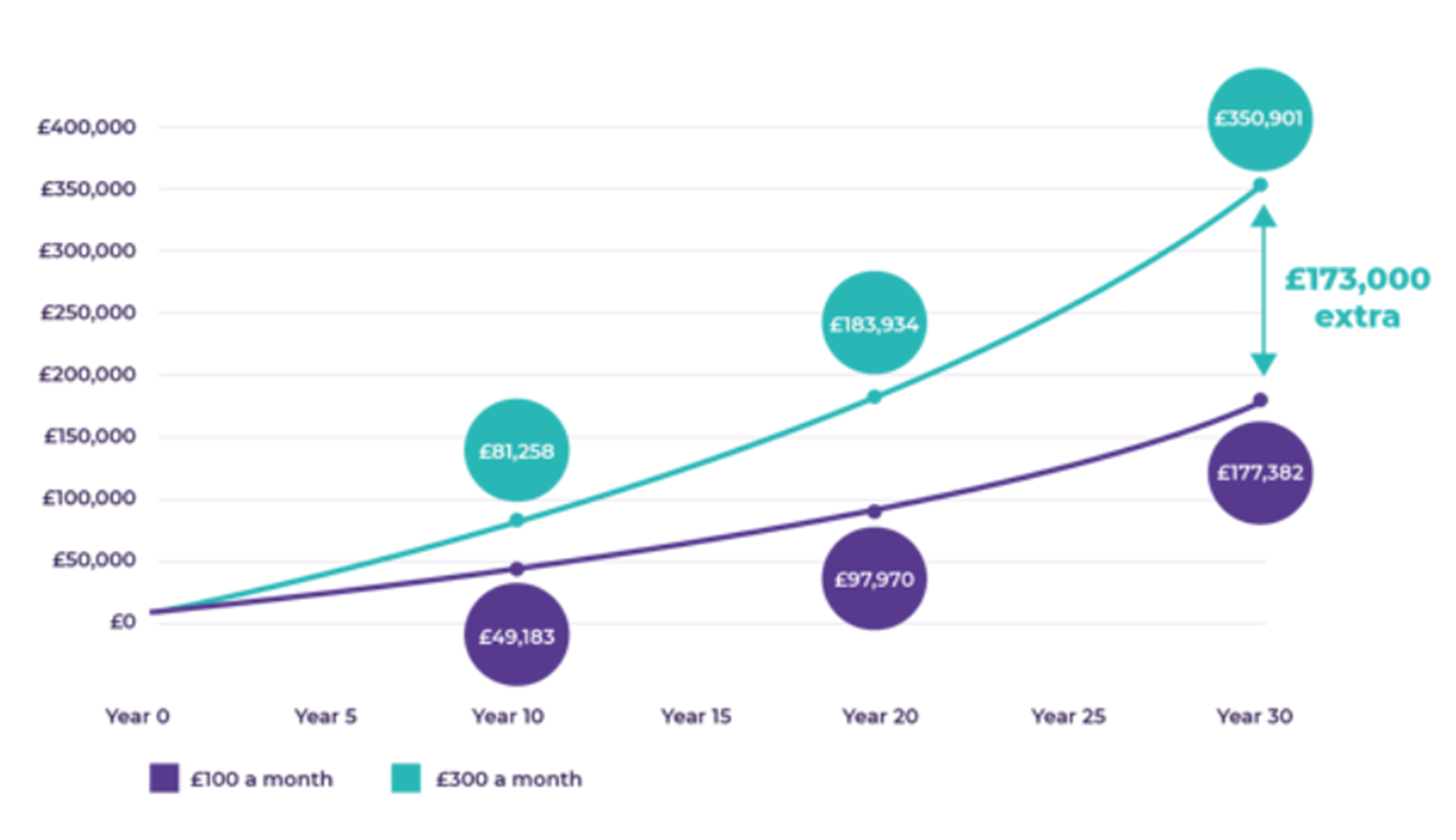
Take the graph below, which is based on monthly contributions of £100 against £300, assuming annual investment returns of 5% and no fees.
Source: Bestinvest
While the difference isn’t overly significant at first, the gap widens over time.
By year 10, contributing three times as much gives you £81,258 compared to £49,183. Then, by year 30, a £300 monthly contribution yields £350,901 – nearly double the £177,382 you’d receive from contributing £100 a month.
Even though contributing £200 more each month might seem like a relatively insignificant difference, compounding could significantly affect your overall retirement income.
This could potentially allow you to live your desired lifestyle or comfortably maintain your standard of living.
There are ways to beat procrastination regarding retirement planning
Thankfully, you can take practical steps to overcome procrastination and put yourself on track for a more secure retirement – here’s how.
Set attainable goals
An effective first step is to set attainable goals. As mentioned, planning for retirement can seem overwhelming, so breaking the process into manageable stages could make everything easier to deal with.
For example, you could start by checking how many pensions you currently hold and reviewing their value.
Then, you could picture your ideal lifestyle and set a new savings target, potentially by increasing your monthly contributions by a small percentage.
These small wins can help build confidence in your overall plan and make the bigger picture easier to approach.
Establish firm deadlines for everything
While you might feel as though deadlines only serve to pressure you, it’s important to establish them for everything.
Without a firm deadline, you may find that distractions in your day-to-day life push retirement planning aside.
You could, for instance, decide that you want to save a certain amount by the end of each tax year.
It might also be prudent to schedule regular reminders to hold you accountable, helping to ensure you don’t put retirement planning on the back burner.
Reward yourself
Rewarding yourself for small victories is one of the most important steps in beating procrastination.
Even though the benefits of retirement planning are often decades away, giving yourself a tangible reward in the present when you take action could help keep you motivated.
This might mean treating yourself to a meal out when you conduct an extensive pension review or making a special purchase when you reach one of your savings targets.
These rewards can make the entire process feel much more engaging.
Seek professional guidance
Even when you focus your efforts as much as possible on planning for the future, it can still seem like somewhat of an uphill battle.
This is where working with a financial planner might help.
We could explain the options available to you and build a bespoke plan that provides clarity and reassurance.
Rather than researching everything yourself, professional guidance could make it much easier to take informed action.
What’s more, knowing you have someone in your corner helping you to navigate the retirement planning process could reduce uncertainty and give you the confidence of knowing you’re on the right track.
To find out how Investment Sense could help you, please email us at info@investmentsense.co.uk or call 0115 933 8433.
Please note
This article is for general information only and does not constitute advice. The information is aimed at retail clients only.
All information is correct at the time of writing and is subject to change in the future.
A pension is a long-term investment not normally accessible until 55 (57 from April 2028). The fund value may fluctuate and can go down, which would have an impact on the level of pension benefits available. Past performance is not a reliable indicator of future performance.
The tax implications of pension withdrawals will be based on your individual circumstances. Thresholds, percentage rates, and tax legislation may change in subsequent Finance Acts.
Please do not act based on anything you might read in this article. All contents are based on our understanding of HMRC legislation, which is subject to change.
The Financial Conduct Authority does not regulate tax planning.